Series : Terminology · Part 17 of 17
- 1. What is a cookie?
- 2. What is a cache?
- 3. What is a VPN?
- 4. What is cloud computing?
- 5. What is a digital memory?
- 6. What is artificial intelligence?
- 7. What is an AI agent?
- 8. What is a token?
- 9. What is RAG?
- 10. What is an embedding?
- 11. What is two-factor authentication (2FA)?
- 12. What is a QR code?
- 13. What is a prompt?
- 14. What is an API?
- 15. What is a NAS? Your own little cloud at home!
- 16. What is cryptocurrency? And what is it for?
- 17. What Is a 3D Printer? Making Things at Home or at Work!
What Is a 3D Printer? Making Things at Home or at Work!
Published
A 3D printer turns a digital model into a real object, layer by layer — to repair and create at home, and to prototype at work.
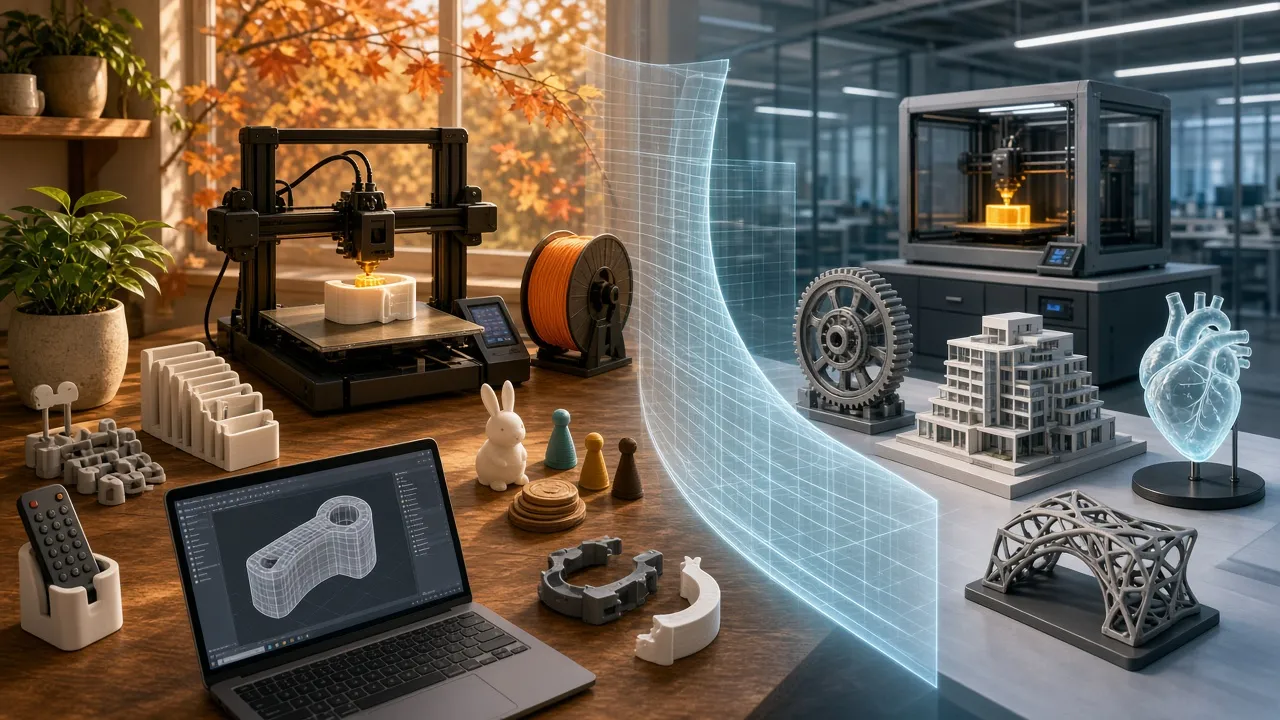
What is a 3D printer? 🖨️
Imagine the small plastic part in your dishwasher breaks.
Instead of ordering a replacement part and waiting several days, you might be able to make it yourself, right at home.
Or imagine a company that needs to test a new mechanical part. Instead of waiting several weeks to receive a prototype, it can make one in a few hours.
Welcome to the world of 3D printing!
A technology that turns a digital model into a real, physical object.
🧱 How does a 3D printer work?
A traditional printer puts ink on a sheet of paper.
A 3D printer, on the other hand, builds an object in three dimensions: width, height and depth.
The most common method for home users is to melt a plastic filament and lay it down layer by layer.
Picture an extremely precise hot glue gun, controlled by a computer.
The printer lays down a first layer, then a second, then a third… until the object is complete.
This method is called additive manufacturing, because material is added rather than cut away from an existing block.
There are also printers that use liquid resin, metal powders and other materials.
🎬 To see what today’s 3D printers look like, here’s a video:
💻 Where do the objects we print come from?
Before you can make an object, you need a three-dimensional digital model.
You have two options.
1. Download an existing model
Platforms such as Printables, Thingiverse and MakerWorld offer thousands of models, free or paid.
You’ll find stands, accessories, figurines, storage boxes and much more.
2. Create your own model
With design software such as Tinkercad or Fusion, you can draw a custom part.
For example, a holder that perfectly fits a remote control, or a small replacement part.
The model is then prepared by software that virtually slices it into layers and sends the instructions to the printer.
🏠 What is a 3D printer good for at home?
This is probably where the technology becomes the most fun!
Here are a few concrete examples.
🔧 Repair instead of throwing away
A broken drawer handle? A missing curtain hook? A small plastic bracket you can’t find anywhere?
It’s sometimes possible to make a replacement part.
Be careful, though: parts that must withstand high temperatures or heavy loads, or that play a safety role, require appropriate materials and testing.
🧰 Organize the house
You can print:
- Drawer dividers.
- Remote control holders.
- Cable organizers.
- Custom hooks and wall mounts.
- Made-to-measure storage boxes.
🎲 Create personalized objects
3D printing also lets you make toys, decorations, figurines, board game accessories and personalized gifts.
A child can even learn to design their own digital creations before seeing them take shape.
🌱 Gardening and DIY
Plant stands, garden labels, drilling guides or jigs for woodworking: the possibilities are endless.
The main advantage is making exactly the object you need, even if it doesn’t exist in stores.
🏭 And in business?
3D printing goes far beyond small plastic objects.
In many sectors, it is changing the way parts are designed, tested and sometimes produced.
🚗 Industry and manufacturing
A manufacturer can print a prototype to check its shape and function before launching a more expensive production run.
It can also make jigs, specialized tools or parts for certain equipment.
Example: a factory creates a custom fixture to make one step on an assembly line easier.
🏥 Health and medicine
3D printing is used to produce anatomical models, some custom prostheses, surgical guides and medical devices.
Example: a medical team can study a physical replica of an anatomical structure before a complex procedure.
These applications obviously require materials, equipment and controls that meet medical standards.
🏗️ Architecture and construction
Architects can print scale models of buildings to present a project to their clients.
Some technologies can even print building components on a large scale, notably with cement-based mixes.
✈️ Aerospace and automotive
In these sectors, 3D printing can be used to make components with complex shapes, sometimes lighter than those produced by traditional methods.
Critical parts must, however, meet strict quality and certification requirements.
🛍️ Small businesses and entrepreneurs
A small business can use a 3D printer to make personalized products or test new ideas.
Example: an entrepreneur creates a specialized accessory, has a few customers try it, and improves the design before producing more.
This makes it possible to develop some products without immediately investing in expensive industrial molds.
💰 How much does a 3D printer cost?
A few years ago, 3D printing was relatively expensive and complex.
Today, some beginner printers cost a few hundred Canadian dollars.
More advanced models can cost several thousand dollars, and industrial equipment much more.
You also need to plan for:
- Filament or resin.
- Tools and accessories.
- Printer maintenance.
- The time needed for design and printing.
- Ventilation and safety measures suited to the materials used.
A small part can take a few minutes to make, while a large object can take several hours.
🤖 And with artificial intelligence?
AI is also starting to make it easier to create three-dimensional objects.
Some tools can help generate 3D models from a description or an image.
Imagine asking:
“Make me a holder to store my four remote controls on a shelf.”
A tool could suggest a first shape that you could then adjust before printing.
But be careful: a model generated by AI isn’t necessarily ready to print or strong enough for its purpose.
AI can speed up design, but you always need to check the object’s dimensions and how well it works.
⚠️ Can everything be printed?
No, and it’s important to understand that.
3D printing has some limits:
- Not every material is suitable for every use.
- Some parts are less strong than their industrially made equivalents.
- Objects may need cleaning or finishing.
- Printing can be slow for large quantities.
- Materials and processes can produce emissions that require proper ventilation.
You also need to respect the copyright and licences of downloaded models.
To make thousands of identical parts, traditional methods are often still more economical.
🍳 The simple version
A 3D printer is a machine that turns a digital drawing into a real object, usually by adding material layer by layer.
At home, it lets you repair, tinker, personalize and create.
In business, it’s used to design prototypes, make specialized tools and produce certain custom parts.
Remember three things:
- At home: make an object suited to a specific need.
- In business: test ideas and produce certain parts faster.
- With AI: make 3D design gradually more accessible.
3D printing changes the way we think about objects: instead of always looking for where to buy a part, we can sometimes ask ourselves how to make it.
And that may be what makes this technology so interesting: it brings manufacturing closer to the people who have the ideas.
☁️ luc.cloud — Tech, simply.