Roblox: Do you really know who your kids are playing with?
Published
Take an interest in what your kids do on Roblox, set up parental controls, and keep the conversation open.
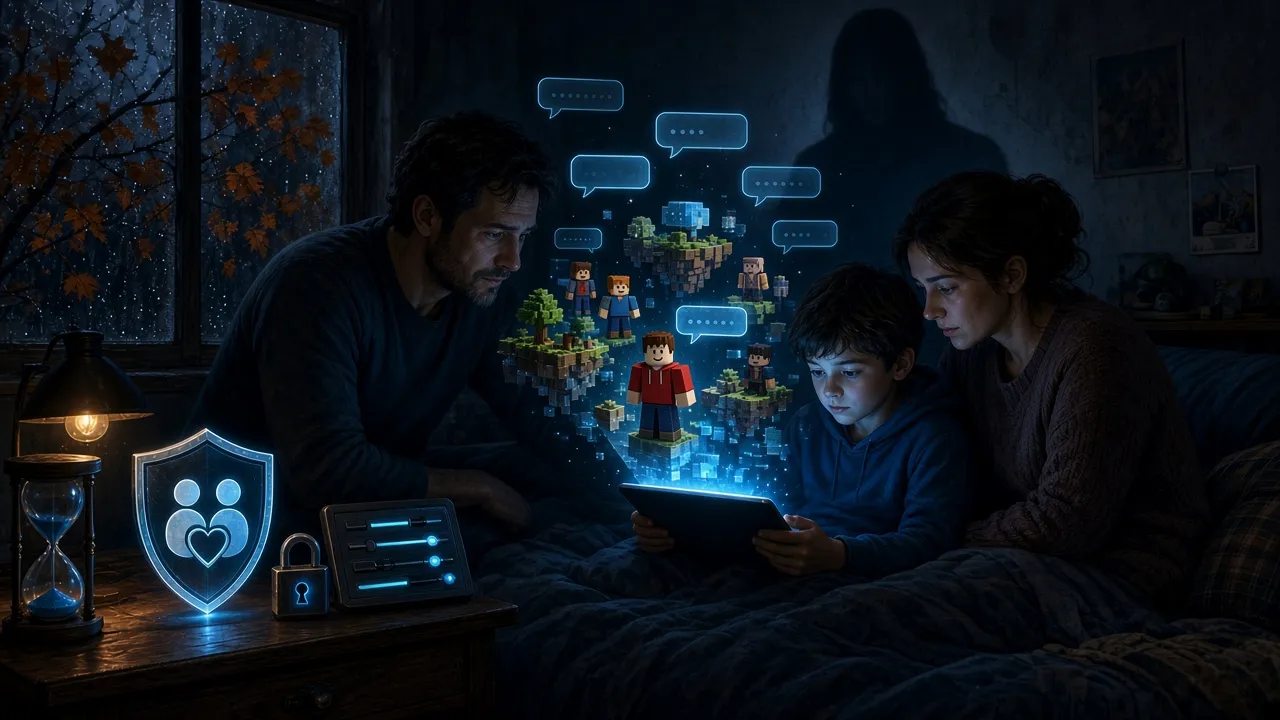
Your child is in their room, quietly settled in front of their tablet.
You hear them laugh. They’re playing Roblox with their friends.
Everything seems perfectly normal.
But here’s an important question:
Do you really know who they’re playing with and who they’re talking to?
Because Roblox isn’t simply a video game. It’s also a vast social universe where children can meet and interact with other people.
And those people aren’t necessarily who they claim to be.
🎮 What exactly is Roblox?
Roblox is a platform that brings together a multitude of games and virtual worlds created by its users.
Children can, among other things:
- explore virtual worlds;
- build and create their own games;
- play with their friends;
- communicate with other players;
- buy virtual items with a currency called Robux.
Roblox can be a wonderful space for creativity and entertainment.
But behind the colorful characters are real people, sometimes strangers.
⚠️ Very real risks
The main issue isn’t necessarily the game itself, but the interactions that can happen there.
A malicious adult could try to gain a child’s trust by presenting themselves as another young person.
They might start by talking about games, become their “friend,” then try to obtain personal information or continue the conversation elsewhere.
This manipulation process is sometimes called grooming—building trust for the purpose of exploitation.
Other risks also exist:
- Inappropriate content: some worlds may present themes that aren’t suitable for every age.
- Cyberbullying: insults, threats, or exclusion among players.
- Scams: promises of free Robux or links to fake sites.
- Spending: virtual purchases that can add up quickly.
- Screen time: difficulty interrupting a game or leaving virtual friends.
These risks don’t mean every Roblox session is dangerous. Rather, they show why parental accompaniment is needed.
📰 Why is Roblox in the news so much?
Children’s safety on Roblox is a major concern for several authorities.
In 2026, Australia’s online safety regulator, eSafety, notably identified gaps that still allowed some contact between adults and children, despite the protections Roblox had announced.
The company then made new commitments to strengthen its safety mechanisms.
Roblox has also introduced age-appropriate accounts and age checks to access communication features.
These improvements matter, but no protection system can completely replace parental vigilance.
🔐 Parental controls: a good starting point
Roblox offers tools that let parents better frame their children’s experience.
To use them, you can create your own Roblox account and link it to your child’s.
Depending on their age, you’ll be able to:
- limit which games are accessible;
- manage or disable conversations;
- view certain information about their activity;
- manage time spent playing;
- limit Robux spending.
To get started, check out the Roblox parental center.
Also take time to verify that the age shown on the account matches your child’s actual age.
Well-configured parental controls are useful, but they don’t guarantee absolute protection.
👨👩👧 The most important thing: take an interest in what our kids do
In real life, you probably want to know where your child goes, who they play with, and what they do.
Why would it be different online?
No need to become a Roblox expert!
Simply start by taking an interest in their world.
Ask them:
- “Show me your favorite game!”
- “Who are you playing with? Are they friends from school?”
- “Do people you don’t know talk to you?”
- “Has anyone ever asked you to continue a conversation on another app?”
- “If something makes you uncomfortable, do you know you can come talk to me about it?”
Even better: take a few minutes to play with them!
You’ll discover what interests them and understand their digital environment much better.
🚨 A few family rules to set
A child should know they must never:
- share their address, phone number, or school name with a stranger;
- share personal photos at a player’s request;
- click links promising free Robux;
- agree to keep a worrying conversation secret;
- meet someone they’ve only known online without telling their parents.
You should also explain that someone who claims to be 12 years old online isn’t necessarily 12.
And above all, if something worrying happens, the child should be able to talk about it without automatically fearing punishment or having their device confiscated.
That trust is essential.
🌐 And it’s not only Roblox!
The same issues exist on other platforms: multiplayer games, Discord, Snapchat, TikTok, and several others.
Children can move from a game to a messaging app, then to a social network, sometimes without parents realizing it.
So it’s important to understand not only what they play, but also how they communicate and with whom.
🍳 The simple version
Roblox isn’t simply a video game. It’s also a space for meeting people and communicating.
The platform offers safety mechanisms, but those don’t replace parental accompaniment.
Remember three things:
- Take an interest in the games and apps your children use.
- Set up parental controls and check the settings regularly.
- Keep the dialogue open so your child dares to tell you about a worrying situation.
We teach our children not to follow a stranger in the street. We also need to teach them to recognize strangers online.
No need to ban everything or watch every second.
What matters is staying present, curious, and available.
Because protecting our children online starts with understanding what they do there.
☁️ luc.cloud — Tech, simply.
Details about Roblox risks and protections are supported by findings from Australia’s eSafety regulator and Roblox’s official parental controls documentation.