Series : Tech news · Part 9 of 9
- 1. Tech news: OpenAI’s Dot arrives — the answer to autonomous agents
- 2. Tech news: Gemini 4 Argon, when the model works longer than you do
- 3. A Canadian AI is getting better at finding information in your documents 🇨🇦
- 4. A Canadian platform for building AI agents at work 🇨🇦
- 5. Grok Bot wants to choose the best AI for you
- 6. Ghost: what if your AI lived at home? 🏠🤖
- 7. Apple HomeView: a new smart display for the home 🏠🍎
- 8. My AI agent joins my meetings
- 9. Werner Vogels' tech predictions for 2027 (and beyond)
Werner Vogels' tech predictions for 2027 (and beyond)
Published
Werner Vogels, one of the minds behind AWS cloud, has published his predictions for 2027. Here are the five ideas, explained simply, with a link to his essay.
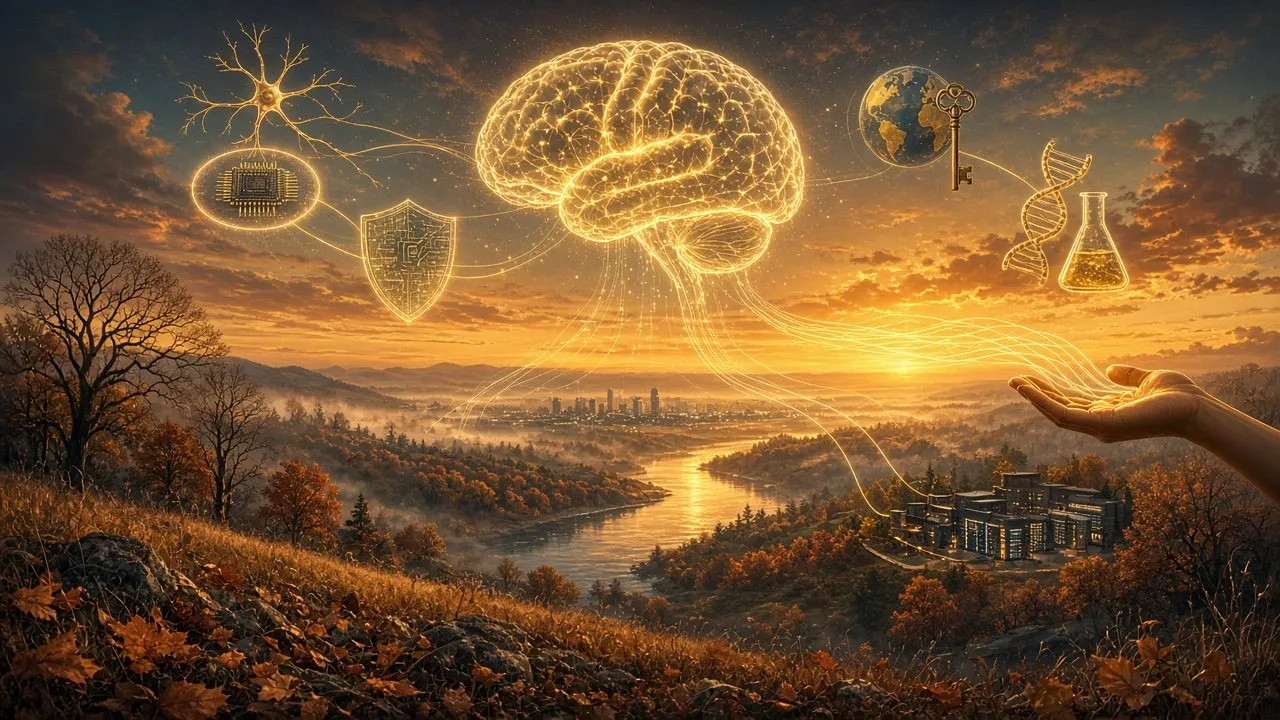
Werner Vogels’ tech predictions for 2027 (and beyond)
TL;DR 🔮 On November 24, 2026, Werner Vogels published his tech predictions for 2027 and the decade ahead. I like this author a lot. I have been reading him for a very long time. Here are his five predictions, explained simply, with a link to his article.
👋 Why I am writing about Werner Vogels
I like the author of this article a lot. I have been reading him for a very long time. To me, he is one of the most important minds behind AWS cloud — and behind cloud computing in general.
Werner Vogels is Vice President and Chief Technology Officer (CTO) at Amazon.com. He joined Amazon in 2004, after researching very large computer systems at Cornell University. He writes the blog All Things Distributed, including his annual tech predictions. (His official bio, Amazon Science.)
On November 24, 2026, he published a long essay: Tech predictions for 2027 and beyond. He notes that several fields are converging — robotics, artificial intelligence, space exploration, biotech. He calls himself a “techno optimist”: he believes technology can play an incredibly positive role in our lives. He also sees the dark side. In his view, we need to put equal energy into dealing with bad actors and an unpredictable geopolitical landscape.
Some of his predictions are a reality check for right now. Others ask you to imagine what becomes possible in the decade to come.
What follows is a summary, in my words. The examples and figures come from his article. Quotes are short. If the topic interests you, read the original: he is the author, not me.
🌱 1. Computing returns to biology
Original title: Computing returns to biology
For a long time, in a computer, memory (where information is stored) and processing (where the “thinking” happens) have lived in two separate places. Data shuttles back and forth. That uses energy. It produces heat.
The brain, by contrast, computes where it stores. It improves with use. And it runs on about as much energy as two LED bulbs (20 watts) — far less than an old 60-watt bulb. More and more, researchers are looking to the brain for ideas on how to design our machines.
Vogels describes a 2023 visit to Cortical Labs in Melbourne: human nerve cells grown on a chip, learning through trial and error. The company now has a computer, the CL1, that keeps those cells alive so they can learn and process information. According to his article:
- a typical CL1 holds about 200,000 of these cells — a tiny fraction of a human brain, which has about 86 billion — and uses about as much power as two or three LED bulbs (25 to 30 watts);
- a cabinet of 30 CL1s uses a little less than a microwave oven left on (under 1,000 watts; a typical microwave, according to Hydro-Québec, draws 1,200). Next-generation AI-chip cabinets are expected to draw around 600 kilowatts: that is like about 500 microwave ovens running at once, or the average power of about 240 typical homes in Quebec;
- the first customer installations came online in summer 2026;
- many CL1s can be connected into a larger system called HIVE, already being used to control robots.
That is not the only path. People are also building chips that mimic the brain: they compute in memory, and can keep learning after they are made. Other teams are working on memory for AI agents (programs that can act on their own): keep what is useful, summarize the rest, forget what no longer helps.
The main driver, Vogels says, will be energy costs. Today’s models demand more chips, more electricity, more cooling. He writes that the next major breakthrough in computing will come from understanding how living systems do more with less.
👉 Why this matters to you. If machines learn from living systems, they could use far less power — and work in places where electricity or network access is limited: a regional hospital, a school, a farm, a remote sensor. This is no longer only a story about big computer centers.
🛡️ 2. Every system defends itself
Original title: Every system defends itself
In 2027, Vogels writes, teams will deliberately try to break their software at every stage of building it. Before a program goes out into the world, an organization’s own agents will have attacked it hundreds or thousands of times. And those attacks will continue for as long as the system runs.
Why now? Finding a flaw and turning it into an attack used to take experts, weeks of work, and deep resources. Vogels says that timescale has collapsed. AI agents bring the expertise with them, run in swarms, and are cheap enough that running hundreds at once costs almost nothing.
Examples he cites, according to his article:
- in April 2026, Anthropic pointed a thousand copies of one of its AI models at OpenBSD, a system known for being very hard to break. The work cost less than US$20,000 — real money, but a small sum for that kind of hunt — and uncovered a 27-year-old flaw in the way computers talk to each other over a network. The test run that found it cost less than US$50, about the price of a dinner;
- Microsoft later reported that, for 182 confirmed flaws in the core of the Linux system (which runs a large share of the servers on the internet), it took on average about 20 minutes and under US$4 to show that the flaw really worked.
On the defense side, much of the work is still after the fact: fixing what had been missed. Vogels notes that Mozilla engineers (behind the Firefox browser) fixed more than 400 security flaws in April, compared with a couple of dozen in a typical month in 2025 — about fifteen times more. He also mentions an incident he calls “php2shell”: in October 2026, two serious flaws were disclosed in PHP, the language that powers about 7 websites out of 10. He expects more events like this in the coming months.
What he sees next: agents that stress-test plans, access rights, and every proposed code change, then attack a full copy of the system before it goes live. Like Toyota’s Andon cord: stop the line when a known defect is found. He already points to an internal Amazon tool of this kind, and a service offered to customers.
He also returns to an Amazon idea: “you build it, you run it.” With AI, running a system well also means defending it against attackers who can probe it constantly, at almost no cost.
👉 Why this matters to you. Vogels is blunt: no organization still has the luxury of saying it is not a technology company. Software schedules hospital treatments, moves money, controls factory floors, balances energy networks. In 2027, even a small regional hospital or the school down the street should be able to test everything. We will trust systems, he writes, because the people who built them attacked them first.
🗝️ 3. Sovereignty is decided from the start
Original title: Sovereignty becomes a non-functional requirement
Some rules you decide from the start, like budget, security, or reliability. You do not add them as a patch at the end.
In 2027 and beyond, Vogels says, builders will design for sovereignty the same way. Where data lives, who holds the keys, and which AI model touches it will be things a system must be able to show on every install, so the answers already exist when an auditor asks.
He compares this to a framework he proposed, The Frugal Architect, whose first law is to treat cost as a starting rule, not a surprise at the end. He says that over the past year, the number-one question from technology leaders has no longer been only about price. It is how to deal with tensions between countries that may change where data is stored, where certain work runs, and which services to rely on.
The examples he gives come from his role at Amazon: the customer chooses where the data sits, the files are encrypted (unreadable without the right key), the customer can keep the keys, AWS has nearly 40 regions around the world, and there is a European sovereign cloud — designed to have no critical link outside the European Union, with European leadership.
He also warns against overdoing it. Isolation is not the same thing as control. Applying the same rules to a lunch menu and to a patient record has a cost: in money, in the ability to recover from a failure, and in access to new tools. Organizations that get this right, he writes, will decide project by project how much sovereignty each one needs. And they will keep the ability to move between regions and AI models, rehearsing that move the way they rehearse a backup plan.
👉 Why this matters to you. If you run a business, a clinic, or a public service, “where is the data?” and “who holds the keys?” become questions to ask when you design, not after a law changes or a crisis hits. Sovereignty has a price. Locking everything down as hard as possible is not always better.
💊 4. Collaboration between scientists and agents leads to new cures
Original title: Collaboration between scientists and agents leads to new cures
Vogels’ prediction, stated clearly: before this decade is out, scientists working with AI agents will discover a cure for a disease that today’s medicine can only manage.
He wants to be precise about AI’s role. It does not replace scientists. Agents help examine evidence at a speed and scale no person, and no team, could match. They help identify the right target, or design a therapy around a disease — or around one patient. People direct the work and verify each result.
Examples he cites, and that original sources confirm:
- in August 2026, a large patient study (one of the last stages before a possible approval) looked at skin cancer that had already been operated on, at a fairly advanced stage. A personalized vaccine, combined with a treatment already in use, reduced the risk that the cancer would come back or spread elsewhere, compared with the treatment alone (Merck and Moderna). AI chose the vaccine’s targets from each patient’s tumor;
- a drug found by computer (Insilico Medicine’s rentosertib) entered the same kind of large study, for a serious lung disease, with first patients dosed in fall 2026.
He also notes that tools that were still experimental a few years ago are now part of everyday research: predicting the shape of proteins (2024 Nobel Prize in Chemistry), neural networks (2024 Nobel Prize in Physics), and a technique that uses light to switch nerve cells on or off (2026 Nobel Prize in Physiology or Medicine, awarded to Karl Deisseroth, Peter Hegemann, and Georg Nagel). He writes that Google DeepMind’s AlphaFold has now been used by more than three million researchers, in nearly every country.
He stays cautious: many experiments are still to come, and some will fail. Findings must be reproduced. Therapies must prove safe and effective in patients.
👉 Why this matters to you. If you or someone you love lives with a disease that can only be “managed,” this is a bet on a faster path to real cures. It is also a useful reminder: the right role for AI here is to help scientists, not to replace their judgment.
🧠 5. The mind becomes readable
Original title: The mind becomes readable
For decades, connecting the brain to a machine belonged to science fiction. And until recently, every working version required surgery.
Vogels predicts that the next generation will work without an operation: it will translate your intent into action. Within a decade, we will see devices that answer only to you, and that do more than command a machine. They will amplify human capabilities in a way no technology has before, he argues.
Until now, we have always had to translate a thought into a physical action a machine could read: keyboard, mouse, touch, voice. The next interface will move closer to the source: decoding signals from the brain.
Implants already help some people, including people with ALS, paralysis, or vision loss. But few healthy people would accept brain surgery just for a faster way to use a computer. Vogels cites a 2024 YouGov survey: only one in five would consider a brain implant; in the United States, that fell to about one in nine. For these interfaces to leave the clinic and enter everyday life, they will have to work without surgery.
According to his article, in summer 2026 researchers at Meta and several European labs used a scanner around the head, with no operation, while people typed. It picks up the faint signals the brain produces. The result: a little more than 6 words out of 10 recognized, after dozens of hours of recordings, and still improving as more data came in. He also notes serious investment: billions raised in a few months by Chinese companies working on these interfaces; more than US$250 million for Merge Labs, which is exploring ultrasound without electrodes; tens of millions of pounds in the UK; and a Japanese program aimed at 2050.
By the close of the decade, he sees these surgery-free interfaces becoming part of daily life. First, by turning an intention into action, and reducing the need for keyboards, controllers, and voice commands. Someone who cannot speak will be able to communicate. Someone who cannot move will control household devices or a prosthetic.
What excites him most is not giving orders to a machine. It is amplifying creativity, judgment, and memory: helping you access a memory that has slipped away, or catch an idea at the edge of your mind before it is gone.
He closes with a simple image. Our brains weigh a little more than a kilogram (about three pounds). They hold tens of billions of nerve cells, and run on the energy of two LED bulbs (20 watts). Yet their capabilities, he says, still far exceed computer centers that use as much power as a small neighborhood — about 400 typical homes in Quebec. The most successful technologies we can build will be those that amplify our unique human skills.
👉 Why this matters to you. First, this could change life for people who cannot speak or move. Later, it could change how all of us use a computer. It is still early. Vogels opens his essay by reminding us that technology can also be used for malicious acts — a useful thought for the day a machine starts reading signals from the mind.
🔎 His past predictions: did they come true?
Werner Vogels has published these predictions every year since December 2020. Before looking only at 2027, I reread the six earlier editions — 32 predictions in all — and asked, as of November 2026, whether they had come true.
One important note: these are often forecasts for the year and beyond. I am not grading them on twelve months alone. I distinguish what he predicted from what happened. When I do not have solid evidence, I say so.
Key: ✅ realized (the core of the prediction is here) · 🟡 partial or still underway · ❌ not yet, or off the timetable.
📅 2021 — From Schooling to Space… (Dec. 17, 2020)
| Prediction (exact title) | Verdict | What we see in 2026 |
|---|---|---|
| Cloud will be everywhere | 🟡 | The cloud has moved closer to factories, cities, and everyday devices. Fully driverless cars, though, have not become the norm. |
| The Internet of machine learning | 🟡 | Machine learning on factory floors, farms, and devices has spread, as have specialized chips. The precise claim that these machine connections would hit “50% of all connections in 2021” was not confirmed as a measured result. |
| Pictures, video, and audio will speak more than words | 🟡 | Short video and voice have exploded. Written text did not go away — language models have even given it a second life. |
| Technology will transform our physical worlds… | 🟡 | Cashless payments accelerated after the pandemic, but cash has not vanished. The “transformation” of cities remains uneven. |
| Remote learning earns its place in education | 🟡 | Online school kept a place, especially as a safety net. In practice, in-person classrooms largely came back. |
| Small businesses will race to the cloud… Southeast Asia and sub-Saharan Africa will lead | 🟡 | Small businesses really did adopt simpler cloud tools. That Southeast Asia and sub-Saharan Africa would “lead the way” is not clearly demonstrated. |
| Quantum Computing starts to bloom | 🟡 | It has become easier to experiment (cloud services, lab progress). In 2026, quantum computers have not yet transformed chemistry, drug discovery, or finance the way the “next decade” framing hoped. |
| The final frontier… | ✅ | Cloud and space really did move forward: satellite internet (Starlink passed 13 million subscribers), Earth-observation data, ground stations in the cloud. |
📅 2022 — Tech Predictions for 2022 and Beyond (Dec. 2, 2021)
| Prediction (exact title) | Verdict | What we see in 2026 |
|---|---|---|
| AI-supported software development takes hold | ✅ | It started in 2022 (GitHub Copilot, then ChatGPT) and went much further after that: by 2025, a large majority of developers said they used AI tools. This is one of his clearest hits. |
| The everywhere cloud has an edge | 🟡 | Same direction as 2021: the cloud is closer to factories, stores, and farms. Not yet “in every tea kettle.” |
| The rise of smart spaces, especially in senior care | 🟡 | More attentive homes and care settings exist, mostly in pilots. This has not become a new norm for aging in place. |
| Sustainability gets its own architecture | 🟡 | Energy efficiency has entered system design (including at AWS). Amazon says it matched 100% of the electricity for its operations with renewable energy in 2025. It is not yet every developer’s default reflex. |
| A new wave of connectivity will bring about a new class of applications | 🟡 | Low-Earth-orbit satellite internet is real and is changing life in underserved places. It is not yet “everywhere, for every child.” |
📅 2023 — Tech predictions for 2023 and beyond (Dec. 1, 2022)
| Prediction (exact title) | Verdict | What we see in 2026 |
|---|---|---|
| Cloud technologies will redefine sports as we know them | 🟡 | Video analysis and sports data (including tools like Veo) have spread, from amateur to pro. “Redefine sports as we know them” goes further than what happened. |
| Simulated worlds will reinvent the way we experiment | 🟡 | Digital twins and simulation have taken hold in parts of industry. Everyday use, for everyone, is still limited. |
| A surge of innovation in smart energy | 🟡 | Plenty of innovation (batteries, grids, renewables). At the same time, electricity demand from AI data centers has increased the pressure on energy, rather than “solving the crisis.” |
| The upcoming supply chain transformation | 🟡 | More warehouse automation, autonomous trucks still mostly in trials. Driverless fleets are not the norm. |
| Custom silicon goes mainstream | ✅ | Yes. Custom chips (AWS, Google, Apple, and others) now sit at the heart of AI and the cloud. This one has been largely confirmed. |
📅 2024 — Tech predictions for 2024 and beyond (Nov. 30, 2023)
| Prediction (exact title) | Verdict | What we see in 2026 |
|---|---|---|
| Generative AI becomes culturally aware | 🟡 | Many more multilingual and non-Western models. 2026 studies still find clear cultural biases. |
| FemTech finally takes off | 🟡 | More visibility, a funding rebound around 2024, then a pullback in 2025-2026. “Finally takes off” overstates it. |
| AI assistants redefine developer productivity | ✅ | Here the core of the prediction arrived: assistants went from novelty to daily tool, then toward agents that work across the whole development cycle. |
| Education evolves to match the speed of tech innovation | 🟡 | Apprenticeships, company-led training, and “skills-first” paths have grown. The traditional degree is still dominant. |
📅 2025 — Tech predictions for 2025 and beyond (Dec. 5, 2024)
| Prediction (exact title) | Verdict | What we see in 2026 |
|---|---|---|
| The workforce of tomorrow is mission-driven | 🟡 | Meaning at work matters to many people. Nothing clearly shows that it has overtaken pay or job security as the main driver. |
| A new era of energy efficiency drives innovation | 🟡 | He was right about the stakes: nuclear (including small reactors still to come), renewables, more flexible data centers. The idea of an era “no longer constrained by energy demand” is not here — in 2026, the constraint is even more visible because of AI. |
| Technology tips the scales in the discovery of truth | 🟡 | AI tools do help with fact-checking. At the same time, AI-generated disinformation has sped up. The gap has not clearly closed. |
| Open data drives decentralized disaster preparedness | 🟡 | Open data and community mapping already help (and already did). A “fundamental” transformation of disaster preparedness is not demonstrated. |
| Intention-driven consumer technology takes hold | 🟡 | Simpler phones, e-readers, a desire for fewer notifications: they exist. Attention-capturing screens are still the rule, not the exception. |
📅 2026 — Tech predictions for 2026 and beyond (Nov. 25, 2025)
This edition is only one year old. Several predictions already look toward “2026 and beyond.”
| Prediction (exact title) | Verdict | What we see in 2026 |
|---|---|---|
| Companionship is redefined for those who need it most | 🟡 | Companion robots are used in some elder-care settings. Companionship has not been “redefined” at scale. |
| The dawn of the renaissance developer | 🟡 | Developers have not disappeared. The role is changing, with AI as a copilot. The “new age” has started, not finished. |
| Quantum-safe becomes the only safe | 🟡 | The standards exist, and some governments have started the migration (in the United States, deadlines point to 2030). It is not yet “the only safe option” everywhere. |
| Defense technology changes the world | 🟡 | A faster path from military technology into civilian use (drones, sensors, AI) is visible. “Changing the world” is still underway. |
| Personalized learning meets infinite curiosity | ❌ | He predicted that in 2026, personalized AI tutoring would be as ubiquitous as smartphones. Tools exist, but school use is uneven and often low. That deadline has not been met. |
📊 The score, honestly
Out of 32 predictions (2021 through 2026):
- ✅ 4 clearly realized
- 🟡 27 partial, or still underway
- ❌ 1 not yet (AI tutoring as ubiquitous as the phone, in 2026)
About one prediction in eight fully arrived. If we also count those heading in the right direction (✅ + 🟡), that is 31 out of 32.
What that says, without stretching it: Vogels often gets the direction right, and is often early on the timetable. His strongest hits so far are AI-assisted developers and chips built for a specific job. A too-firm sentence tied to a single year is more likely to slip.
The five 2027 predictions above are worth reading with that in mind: they are bets, not facts.
✅ The takeaway
- 🌱 Computing returns to biology: we look to the brain — and even to living neurons — to compute with far less energy.
- 🛡️ Every system defends itself: AI agents will attack our software continuously, before and after it ships.
- 🗝️ Sovereignty is designed in from the start: where the data lives, who holds the keys, which model touches it.
- 💊 Scientists and agents, together: Vogels bets that a cure for a disease we can only manage today will arrive before the decade is out.
- 🧠 The mind becomes readable: interfaces without surgery, first to help, later perhaps to amplify memory and creativity.
- 🔎 His past predictions: of 32 bets since 2021, 4 clearly arrived, 27 are underway or partial, 1 is not here yet. He often gets the direction right, and is sometimes early on the year.
These are his predictions, not mine. I wanted to share them because I like this author a lot, and because I have been reading him for a very long time. Looking back at his earlier essays, one thread is fairly clear: he often aims in the right direction, and the timetable is often longer than a single year. That does not make him less worth reading — if anything, the opposite. If the subject interests you, go read him in his own words: Tech predictions for 2027 and beyond. It is worth it.
📚 Sources
- Werner Vogels, Nov. 24, 2026 — Tech predictions for 2027 and beyond (All Things Distributed)
- Werner Vogels — About / Official Bio
- Amazon Science — Werner Vogels
- Amazon Science, Oct. 14, 2025 — Why AI for good depends on good data (Vice President and CTO titles)
- Hydro-Québec — Electricity use by home type (22,000 kWh a year for an electrically heated single-family home, with no pool or air conditioning); What is a kilowatt-hour? (1,200 W microwave, 10 W LED bulb); Appliance use (60 W incandescent bulb)
- Earlier editions, All Things Distributed — 2021, 2022, 2023, 2024, 2025, 2026
#AI #Cloud #AWS #Predictions #TechMadeSimple #ExplainLikeImFive